
Note 03
Passivation of stainless steel, and why it fails
Stainless steel is not corrosion resistant because chromium is a noble metal. It is not. Stainless steel is corrosion resistant because chromium reacts with oxygen faster than iron does, and the oxide it forms is dense, adherent and self-repairing.
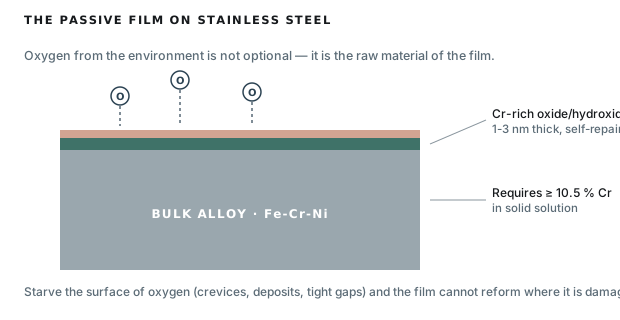
Two conditions have to hold. The alloy must contain at least about 10.5 % chromium in solid solution, and oxygen must be able to reach the surface. Both are routinely violated in service, and each violation has a characteristic failure signature.
Passivation is not pickling
These are different processes with different purposes, and they are constantly confused in specifications.
| Pickling | Passivation | |
|---|---|---|
| Purpose | Removes heat tint, scale and the chromium-depleted layer beneath it | Removes free iron contamination and accelerates film formation |
| Typical medium | Nitric–hydrofluoric acid mixture | Nitric acid, or citric acid |
| Removes metal? | Yes, a thin layer | Essentially no |
| Fixes weld heat tint? | Yes | No |
A specification that calls for passivation after welding, without pickling, does not address the heat tint. This single substitution accounts for a large share of the “the stainless is rusting” enquiries we receive.
Four ways the film is defeated
1. Free iron contamination
Carbon steel particles embedded in a stainless surface will rust, and the rust staining is usually mistaken for failure of the stainless itself. The sources are predictable: carbon steel wire brushes, grinding discs previously used on carbon steel, shared fabrication tables, and carbon steel lifting equipment. Segregating tooling costs almost nothing. Removing the contamination afterwards costs a great deal.
2. Weld heat tint
The coloured oxide beside a weld indicates a chromium-depleted zone beneath it. Darker colours mean more depletion. In benign environments the tint is cosmetic; in chloride service it is where pitting starts. It must be removed mechanically or by pickling, and back-purging during welding is what prevents it forming in the first place.
3. Oxygen starvation
Under a gasket, inside a crevice, beneath a deposit or under a fouling layer, dissolved oxygen is consumed and not replenished. The film cannot reform where it is damaged. This is the origin of crevice corrosion, and it is why stainless steel performs worse under a wrap or a poorly fitting gasket than it does fully exposed to the same fluid.
4. Reducing acids
Hydrochloric acid, and other reducing acids, dissolve the film faster than it can reform. Stainless steel has no useful resistance to hydrochloric acid at any concentration of practical interest, and specifying it for that service will not end well regardless of grade.
Give it time and air. A clean stainless surface will passivate naturally in air. Chemical passivation accelerates a process that would happen anyway; it does not create resistance that the alloy does not have. If a component has been chemically passivated and still rusts, the problem is contamination, heat tint or geometry — not the passivation step.
What to write into a specification
- Dedicated stainless-only tooling and consumables, with segregated storage.
- Back-purge requirements for welds where the root will be wetted, with an oxygen limit.
- Pickling or mechanical removal of heat tint where the service is chloride-bearing, with an acceptance criterion that someone can actually apply on site.
- Passivation to ASTM A967 where free-iron contamination is credible, with the test method named.
- Chloride limits on hydrotest water, and a drying requirement afterwards.
Download this note as a PDF for circulation or filing.
Standards and further reading
- ASTM A967 — Chemical passivation treatments for stainless steel parts.
- ASTM A380 — Cleaning, descaling and passivation of stainless steel parts, equipment and systems.
- ISO 16048 — Passivation of corrosion-resistant stainless steel fasteners.
- AWS D18.2 — Guide to weld discolouration levels on the inside of austenitic stainless steel tube.