
Note 02
Chloride pitting and the limits of PREN
Pitting is the most common reason stainless steel is taken out of service, and chloride is almost always the agent. It is a localised breakdown of the passive film that becomes self-sustaining once it starts.
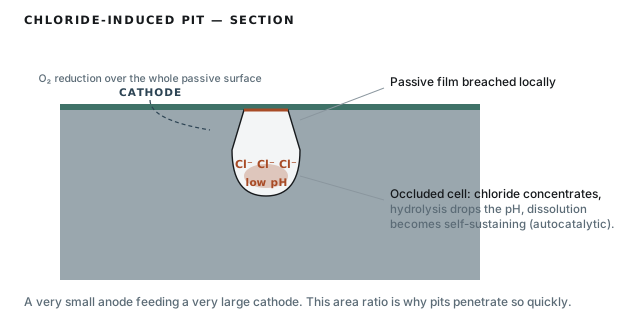
The sequence is worth understanding because it explains why pits accelerate rather than slow down. Chloride ions adsorb at a weak point in the passive film and break it down locally. Metal dissolves at the exposed site. The dissolved metal ions hydrolyse, which lowers the pH inside the pit. Chloride migrates in to balance the charge. The result is a small volume of concentrated, acidified chloride solution that prevents the film from reforming, sitting inside a component whose entire outer surface is available to act as a cathode. The reaction supplies its own conditions.
What PREN is
The pitting resistance equivalent number is an empirical weighting of the three alloying elements that most affect resistance to chloride pitting:
PREN = %Cr + 3.3 × %Mo + 16 × %N
Some duplex-specific versions use a factor of 30 for nitrogen. Tungsten-bearing grades add a term for tungsten. Which variant is used matters when comparing published figures, and the variant is often not stated.
| Grade | Typical composition | PREN | Common judgement |
|---|---|---|---|
| 304 / 1.4301 | 18Cr, 8Ni | 18–19 | Indoor and mild atmospheres |
| 316L / 1.4404 | 17Cr, 10Ni, 2.1Mo | 24–26 | Marine atmosphere; not seawater immersion |
| 2205 duplex / 1.4462 | 22Cr, 5Ni, 3.1Mo, 0.17N | 34–36 | Chloride process service |
| 904L / 1.4539 | 20Cr, 25Ni, 4.3Mo | 34–36 | Acid and chloride service |
| 254 SMO / 1.4547 | 20Cr, 18Ni, 6.1Mo, 0.2N | 43–45 | Seawater, with limits |
| Alloy 625 / 2.4856 | 21Cr, 9Mo, 3.6Nb | 50+ | Severe service |
What PREN is not
PREN ranks alloys. It does not predict behaviour, and it carries no units of anything physical. Four things it cannot capture matter more than the number itself.
Temperature. Pitting resistance falls sharply with temperature, and each alloy has a critical pitting temperature below which pits do not initiate in a given solution. Measured to ASTM G48 Method E, 316L typically sits around 15 °C, 2205 around 35 °C and 6 % molybdenum grades around 70 °C in the standard ferric chloride test. Those are test numbers in a specific solution, not service limits, but the ordering and the size of the steps are real. An alloy chosen on PREN alone and then run 20 °C hotter than assumed has no margin left.
Surface condition. A ground or pickled surface resists pitting substantially better than an as-welded one. Weld heat tint — the coloured oxide beside the weld — sits over a chromium-depleted layer and is a preferential initiation site. Two components of identical composition can differ by a wide margin in service purely because one was cleaned properly.
Crevices. Crevice corrosion follows the same mechanism as pitting but initiates far more readily, because the occluded geometry is supplied by the design rather than having to be created. Critical crevice temperatures typically run 15 to 25 °C below the critical pitting temperature for the same alloy. Gasket faces, tube-to-tubesheet joints, washers, tape wraps and deposits are where stainless steel fails first.
Stagnation. Stagnant chloride water is much more aggressive than flowing water, because deposits settle and the local chemistry is never refreshed. Hydrotesting seawater left in a system over a shutdown has ruined a great deal of correctly specified stainless steel.
316 is not a seawater material. It is specified for seawater immersion more often than any other error we see. It performs acceptably in marine atmosphere and poorly in continuous immersion, particularly where there are crevices or stagnant periods. If the duty is seawater, the conversation starts at 6 % molybdenum grades, super duplex, or a non-stainless solution.
Using PREN sensibly
Use it to shortlist, then verify against the operating temperature, the chloride concentration, the surface finish that will actually be delivered, and the crevices the design contains. If the margin between candidate alloys comes down to two or three PREN points, the number is not the thing deciding the outcome — fabrication quality is.
Download this note as a PDF for circulation or filing.
Standards and further reading
- ASTM G48 — Pitting and crevice corrosion resistance of stainless steels and related alloys by use of ferric chloride solution.
- ASTM G150 — Electrochemical critical pitting temperature testing of stainless steels.
- ISO 15156 / NACE MR0175 — Materials for use in H₂S-containing environments in oil and gas production.
- EN 10088-1 — Stainless steels: list of stainless steels and their compositions.