
Note 06
Hydrogen embrittlement in high-strength fasteners
A high-strength bolt that fails hours or days after installation, with no overload and no visible corrosion, is usually a hydrogen embrittlement failure. The delay is the characteristic feature and the reason it is so often misdiagnosed as a supply problem.
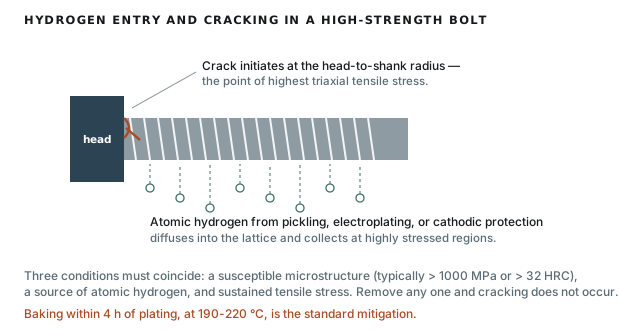
Three conditions, all required
- A susceptible microstructure. Risk rises steeply above roughly 1000 MPa tensile strength, or about 39 HRC. Property class 8.8 fasteners are generally tolerant; 10.9 needs care; 12.9 is genuinely vulnerable and should not be electroplated without a controlled process and a strong reason.
- A source of atomic hydrogen. Acid pickling before plating, the electroplating bath itself, cathodic protection, and corrosion in service all generate atomic hydrogen at the steel surface, where it can enter the lattice rather than combining into harmless molecular hydrogen.
- Sustained tensile stress. The preload is normally sufficient on its own; residual stresses from forming add to it.
Remove any one and cracking does not occur. In practice the strength is fixed by the design and the stress is the point of the fastener, so control is exercised over the hydrogen.
Internal and environmental embrittlement
Internal hydrogen embrittlement comes from hydrogen introduced during manufacture, chiefly pickling and electroplating. It is the mechanism behind failures in the first hours or days after tightening, and it is preventable by process control.
Environmental hydrogen embrittlement comes from hydrogen generated in service — by a corrosion reaction on the fastener, or by an over-driven cathodic protection system on the structure it is part of. It can appear at any point in the life of the assembly, and it is controlled by material selection and by not over-protecting.
Baking
Baking drives absorbed hydrogen back out before it can concentrate at stressed regions. Two details determine whether it works.
Timing. Baking must begin as soon as practicable after plating, and within a few hours at most. Hydrogen that has already reached and initiated a crack cannot be recovered by a later bake.
Temperature and duration. Typically 190 to 230 °C for between 4 and 24 hours depending on strength, section and coating. Higher-strength parts need longer, not hotter, since the temperature is limited by the tempering temperature of the steel.
Baking is a mitigation, not a guarantee. Zinc plating in particular forms a relatively impermeable barrier that slows hydrogen egress, which is one reason electroplated high-strength fasteners remain a managed risk even when baked correctly.
Avoiding the hydrogen instead
The more reliable route for high-strength fasteners is a coating process that does not generate atomic hydrogen at the surface at all:
- Zinc flake coatings applied by dip-spin and cured, with no acid pickling and no electrolytic step. This is the usual answer for property class 10.9 and above.
- Mechanical zinc plating, which deposits zinc by peening rather than electrochemically.
- Hot-dip galvanising, subject to its own constraints on thread fit and on the maximum property class that may be galvanised.
A practical rule. If a fastener is property class 10.9 or above and the drawing calls for electroplating, treat it as a question to be answered rather than a detail to be procured. In most cases a zinc flake system meets the corrosion requirement without introducing the mechanism at all.
Recognising it after the fact
Hydrogen embrittlement failures are brittle, with little or no plastic deformation, and they initiate at the head-to-shank radius or the first engaged thread root. Fracture surfaces are typically intergranular near the origin, changing to a ductile mode as the remaining section overloads. That intergranular origin is the diagnostic feature, and it requires scanning electron microscopy to see — which is why fracture surfaces should not be cleaned, handled or fitted back together before examination.
Download this note as a PDF for circulation or filing.
Standards and further reading
- ISO 4042 — Fasteners: electroplated coating systems, including requirements for hydrogen embrittlement relief.
- ISO 15330 — Fasteners: preloading test for the detection of hydrogen embrittlement (parallel bearing surface method).
- ASTM F1940 — Process control verification to prevent hydrogen embrittlement in plated or coated fasteners.
- ASTM B850 — Post-coating treatments of steel for reducing risk of hydrogen embrittlement.
- ISO 10683 — Fasteners: non-electrolytically applied zinc flake coating systems.