
Note 05
Reading ISO 12944 before you write a coating specification
ISO 12944 is the standard most protective coating specifications are written against, and it is also the standard most often cited without being read. Two misunderstandings account for most premature failures we investigate: the corrosivity category is chosen carelessly, and the durability range is treated as a guarantee.
The corrosivity category
Part 2 classifies atmospheric environments by the first-year corrosion loss of unprotected low-carbon steel. The categories run from C1 to CX, and the steps between them are large.
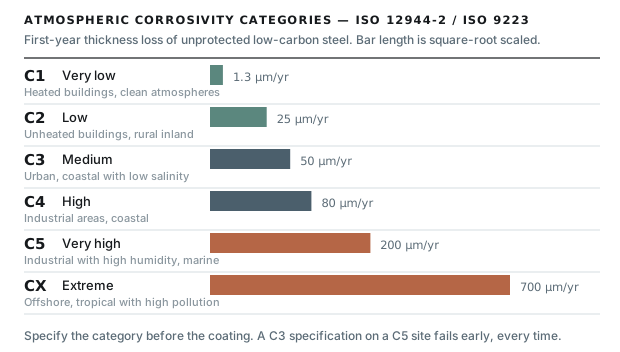
The category is a property of the site, not of the project. A structure 500 m from a shoreline is not in the same category as one 5 km inland, and a splash zone is not in the same category as the deck above it. Where a structure spans environments — a jetty, a bridge over an estuary, a tank farm with one face toward the sea — it needs more than one category and more than one system.
There are separate categories for water and soil immersion (Im1 to Im4), which are not interchangeable with the atmospheric ones. A CX specification does not cover a buried section.
Durability is not a warranty
Part 1 defines durability ranges: low, up to 7 years; medium, 7 to 15 years; high, 15 to 25 years; and very high, more than 25 years. The standard is explicit that these are a technical expectation used to plan maintenance, and not a guarantee period. Durability is defined as the time to first major maintenance, which the standard relates to a defined degree of rusting — not the time until the coating looks tired.
Writing “25 year system to ISO 12944” into a contract and expecting it to function as a 25-year warranty is a misreading that has produced a great deal of litigation. If a warranty is wanted, it has to be negotiated separately and it will be priced separately.
Surface preparation decides the outcome
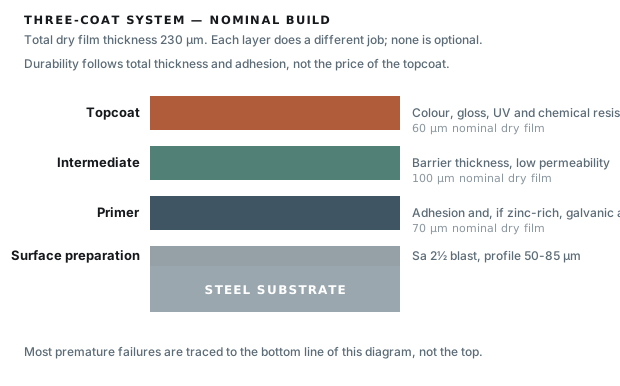
Adhesion is established at the substrate, and no subsequent layer recovers what is lost there. The specification needs to state the cleanliness grade, the surface profile, and the soluble salt limit — all three, with methods.
- Cleanliness to ISO 8501-1. Sa 2½ (very thorough blast cleaning) is the normal requirement for the systems in Part 5.
- Profile to ISO 8503, typically medium (G), giving roughly 50 to 85 µm. Too smooth and adhesion suffers; too coarse and the peaks are not covered by the primer.
- Soluble salts to ISO 8502-6 and 8502-9. Chloride left on the surface draws moisture through the film and causes blistering that no amount of coating thickness prevents.
Conditions during application
Most of the requirements that get waived on site are the ones that matter. Steel temperature must be at least 3 °C above the dew point during application and cure. Relative humidity limits, minimum and maximum overcoating intervals, and minimum steel temperature all come from the product data sheet, and all of them are routinely exceeded when a programme slips. Exceeding the maximum overcoating interval, in particular, produces an intercoat adhesion failure that will not be visible at handover and will be obvious in three years.
Write down the inspection hold points. A specification that states a requirement but does not say who verifies it, when, and against what record, is a specification that will be met on paper. Surface cleanliness, profile, salt level, dew point and wet film thickness all need to be recorded before the next layer is applied, because none of them can be checked afterwards.
A short checklist
- Corrosivity category per zone, assessed for the actual site.
- Required durability, stated as a range and understood as a maintenance interval.
- Surface preparation grade, profile and salt limit, each with a test method.
- System build: generic types, number of coats, nominal and minimum dry film thickness.
- Application conditions and overcoating intervals, taken from the actual product sheet.
- Inspection hold points and the records to be produced at each.
- Repair procedure for damage in transit and at erection, specified before it happens.
Download this note as a PDF for circulation or filing.
Standards and further reading
- ISO 12944-1 — General introduction, including durability ranges.
- ISO 12944-2 — Classification of environments.
- ISO 12944-5 — Protective paint systems.
- ISO 12944-8 — Development of specifications for new work and maintenance.
- ISO 12944-9 — Protective paint systems and laboratory performance test methods for offshore and related structures.
- ISO 8501-1, ISO 8502-6, ISO 8502-9, ISO 8503 — Preparation of steel substrates: cleanliness, soluble salts and surface profile.